

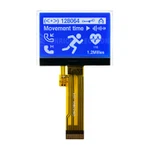
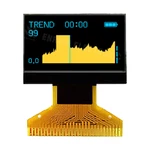


1.2 Inch 128x64 Graphic LCD ST7567A 6 O'Clock

1.2 Inch 128x64 Graphic LCD ST7567A 6 O'Clock suppliers

1.2 Inch 128x64 Graphic LCD ST7567A 6 O'Clock factory

1.2 Inch 128x64 Graphic LCD ST7567A 6 O'Clock best

1.2 Inch 128x64 Graphic LCD ST7567A 6 O'Clock high quality

1.2 Inch 128x64 Graphic LCD ST7567A 6 O'Clock price
1.2 Inch 128x64 Graphic LCD ST7567A 6 O'Clock
♦Resolution : 128X64
♦Drive IC : ST7567A
♦Viewing Angle : 6 0’ CLOCK
♦DISPLAY MODE : FSTN/TRANSFLECTIVE/POSITIVE
ENH-DG128064-110 Description:
1.2 Inch 128x64 Graphic LCD ST7567A 6 O'Clock: What I've Learned Integrating This Module
I've been on the supplier side of monochrome graphic LCDs for long enough to have a strong opinion about the 128x64 class. Most of them are interchangeable on paper. The difference shows up when you actually try to fit one into a product, and the 1.2 Inch 128x64 Graphic LCD ST7567A 6 O'Clock is a good example of why.
This module is small-1.2 inches diagonal, COG construction, FPC tail. But the decisions that determine whether it works in your design aren't about the 128x64 resolution. They're about the controller's interface behavior, the optical configuration, and whether the polarizer orientation matches how your enclosure sits relative to the user's eye. Those are the things I want to walk through.
The ST7567A Interface Question Comes Up Every Time
Almost every inquiry we get about this module includes the same question in different words: "Can I use I²C instead of SPI?" The answer depends on whether the module exposes the SI2 pin. On the versions we build, SI2 is brought out to the FPC, so the same hardware can run 4-line SPI or I²C depending on how you strap that pin. That's not a trivial detail. I've watched a customer go through a full PCB respin because they assumed every ST7567A module had a fixed interface. The controller supports 8-bit parallel, 4-line SPI, 3-line SPI, and I²C according to the Sitronix datasheet, but the module maker decides which of those actually reaches the connector. Ask before you design the board.
There's a second thing about the ST7567A that's worth knowing. The 1/65 duty, 1/9 bias scheme it runs on this module is standard, but the power-up sequence is less forgiving than the command set suggests. We ship a verified initialization routine in C with production orders because the delays matter. Customers who write their own from the datasheet often come back with a display that lights up but shows garbage. It's almost always the reset timing.
Why 6 O'Clock and Positive Transflective Belong Together
I've seen design teams treat viewing direction and polarizer mode as independent checkboxes. They're not. On this module, 6 o'clock and positive transflective are a matched pair, and swapping one without thinking about the other usually produces a display that looks wrong in the field.
The 6 o'clock axis assumes the user's eye is above the screen. That's the normal posture for a handheld meter, a compact controller, or a panel mounted below shoulder height. Flip the module 180 degrees and you lose off-axis contrast-not because anything failed, but because the polarizer is doing what it was cut to do. If your enclosure puts the display above eye level, you need a 12 o'clock variant, and that's a tooling conversation, not a jumper change.
The positive transflective mode is the other half. In a lit room, it reflects ambient light. In a dim room, the backlight takes over. I've had customers ask for negative transmissive instead because they like the black background look, and then come back a month later saying the display is too dependent on backlight current for their battery budget. Negative mode is a backlit configuration by nature. Positive transflective is the lower-power choice, and on a 1.2-inch module going into a portable product, that usually matters more than aesthetics.
COG + FPC at This Size Is a Different Mechanical Problem
At 1.2 inches, the module outline is roughly the size of a large postage stamp. COG construction keeps the controller die on the glass, which is why there's no chip package or PCB adding thickness behind the display. The FPC tail then handles the connection to your board. On paper this is straightforward. In practice, the FPC length and exit direction decide whether the module fits at all.
We've done FPCs that exit from the side for enclosures where the board sits perpendicular to the display. We've done longer tails for products where the main PCB is on the other side of a battery compartment. The standard tail works for a lot of designs, but "standard" here is a starting point, not a constraint. What doesn't change easily is the glass outline and active area-those are tooling. If you need a different diagonal or a non-rectangular shape, that's a new mask and a longer lead time.
One more mechanical note. COG modules are not hand-solder friendly in the way through-hole COB modules are. If you're building ten units on a bench, plan for hot-bar or a ZIF connector on your board. If you're running SMT, the FPC is an advantage. I've seen both scenarios, and the process decision should come before the first sample order, not after.
Where I've Actually Seen This Module Used
The medical inquiries are the most consistent. Blood pressure monitors, oximeters, compact patient monitors-128x64 is enough for multi-line readings and a few icons, and the positive transflective mode holds up in both dim exam rooms and brighter clinical spaces. The -10°C to +60°C operating range covers the transport and storage conditions these devices see, though if you're shipping to colder climates, that's worth raising early because the extended variant uses different fluid and adhesive.
Industrial meters are the second cluster. Pressure gauges, flow meters, calibration tools. The ST7567A's interface options fit the range of MCUs in those designs, from older 8-bit controllers with SPI to more integrated platforms running I²C. The 3V logic supply lines up with the rest of the low-power electronics in those products.
And then there's the handheld and appliance control segment, where a character LCD is too limited and a TFT is over-specified. The 1.2-inch size is small enough for compact enclosures but large enough for multi-line text. Positive transflective means you're not burning backlight current every time someone glances at the screen.
What We Can Change, and What We Can't
FPC layout is the most common customization. Length, exit direction, pin assignment-all adjustable. Backlight color is also routine; white is standard, but blue, green, and amber come up often enough that we keep the options on the table. Polarizer mode is a bigger conversation. Positive transflective is the baseline for this module, but if your application genuinely needs negative transmissive, that's a different build and should be specified before tooling.
The glass outline and active area are fixed once tooling exists. That's not a limitation unique to us; it's how the mask works. If you need a different size, plan for a new mask and the qualification time that comes with it.
MOQ for standard configurations is 1,000 pieces. Custom FPC or backlight builds usually land at 3,000, though we'll negotiate for pilot quantities. Samples are available with a nominal fee that comes off the production order.
FAQ
Q1: How do I know if my module exposes the SI2 pin for interface selection?
Ask for the FPC pinout drawing before you commit. The ST7567A supports multiple interfaces, but the module maker decides which pins reach the connector. On our builds, SI2 is available, but this varies by supplier and by part number.
Q2: Is positive transflective readable outdoors without backlight?
Yes, in direct sunlight the reflective component does the work. Contrast is lower than a backlit indoor setting, but the display remains legible. That's the point of transflective-it's not a pure reflective display, and it's not a pure transmissive one.
Q3: What's the real difference between this and the 2.24-inch 128x64 with the same controller?
Same controller, same resolution, different physical size and active area. The 2.24-inch version suits panel-mounted instruments where viewing distance is greater. The 1.2-inch version is for handheld and space-constrained products. Don't pick based on resolution alone.
Q4: Can the operating temperature range be extended?
The standard build is -10°C to +60°C operating, -20°C to +70°C storage. Extended ranges require different LCD fluid and polarizer adhesive, so it's a different build, not a spec tweak. Raise it during the inquiry, not after samples.
Q5: Do you provide initialization code?
Yes, for production orders we include a verified C routine with the power-up sequence and register settings. The ST7567A command set is documented in the Sitronix datasheet, but the reset and delay timing is where most self-written sequences fail.
Q6: Can the FPC be customized?
That's the most common request we get. Length, exit direction, and pin assignment are all adjustable. It directly affects whether the module fits the enclosure without a mechanical compromise, so it's worth settling early.
Evaluating the 1.2 Inch 128x64 Graphic LCD ST7567A 6 O'Clock
This module isn't trying to be a high-resolution display or a sunlight-readable outdoor panel. It's a compact monochrome graphic LCD with a controller that's been in production for years, a COG + FPC construction that fits where thicker modules won't, and an optical configuration that's matched to how handheld and panel-mounted products are actually viewed. If that fits your design, send over your interface requirements and mechanical constraints. We'll confirm the FPC layout and polarizer orientation against your enclosure and come back with a quote.

SPECIFICATIONS
| ITEM | DIMENSION | UNIT |
|---|---|---|
| Size | 1.2 |
inch |
|
Viewing Angle |
6 0' CLOCK |
|
|
Outline Dimention |
28.58x19.5x1.7(MAX) |
mm |
| Display rea | 24.3 x12.78 | mm |
| Drive IC | ST7567A | |
| DISPLAY MODE |
FSTN/TRANSFLECTIVE/POSITIVE |
|
| Connector | COG+FPC | |
| Operating Temperature | -10°- +60° | °C |
|
Storage Temperature
|
-20°- +70° |
°C |
|
Drive Method
|
1/64 Duty,1/9 Bias,Vop=8.7 V, Vdd=3.0V |
|
| Backlight | 3PCS WHITE LEDS,IF=45mA & VF=3.0±0.10V |
Contact us integrity, punctuality,innovation , win-win
Enrich,make it easier to use LCD:

Name:Cassie Huang

Email: cassie@rxxdisplay.com

Name: Jessie Lv

Email: jessie@rxxdisplay.com

3rd Floor,Bldg 11 HuaFeng ,International Intelligent Manufacturing Building,Wanle Road,Shajing Town,BaoAn District,Shenzhen,China

Hot Tags: 1.2 inch 128x64 graphic lcd st7567a 6 o'clock, manufacturers, suppliers, factory, customized
You Might Also Like


Send Inquiry