



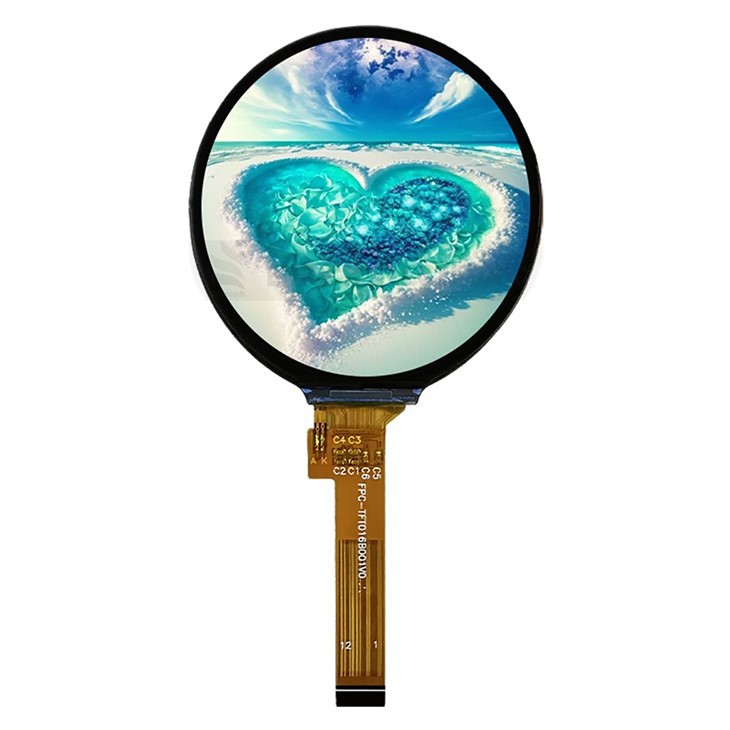


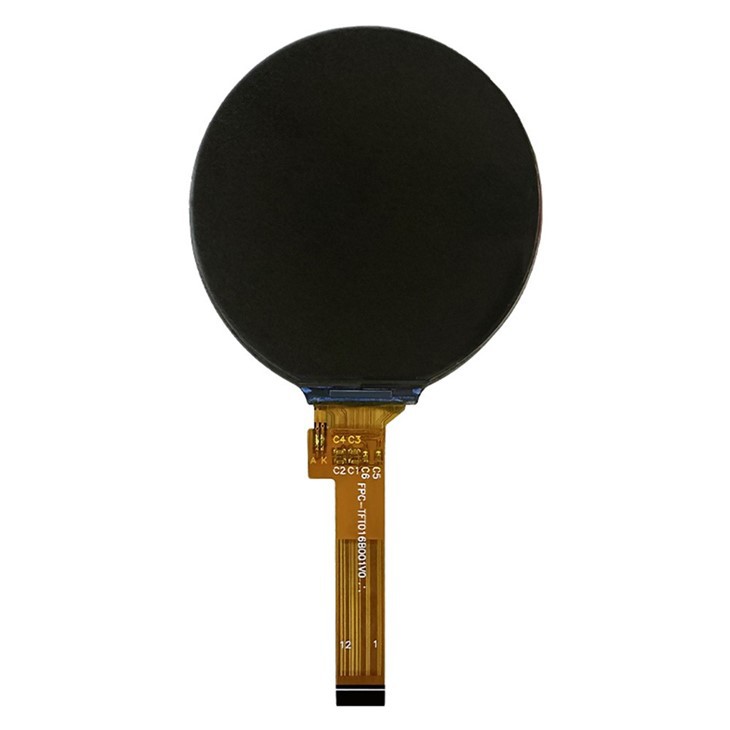
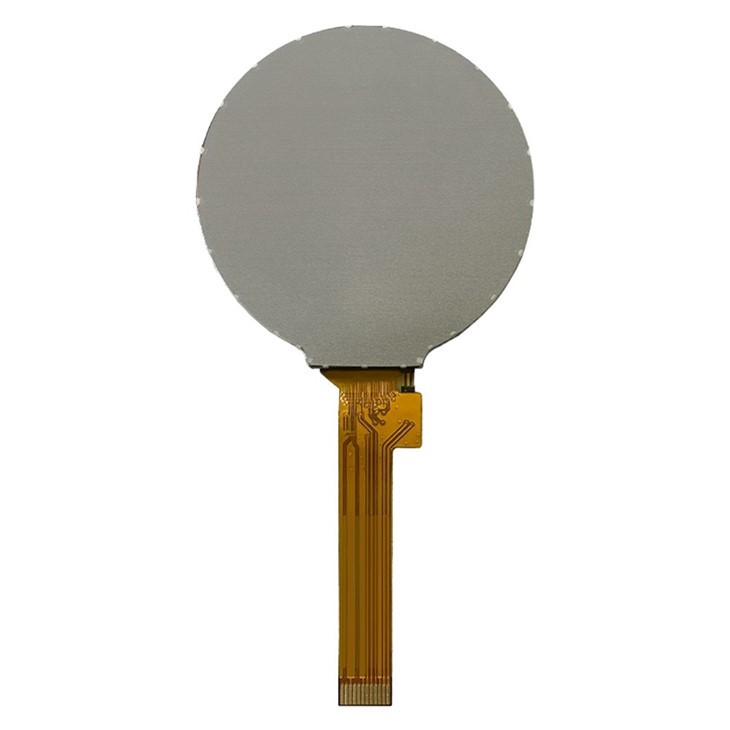
1.6 Round TFT LCD Module
♦Interface: MIPI
♦View Direction: ALL
♦Driving IC: ST7797
♦Touch Screen : Without touch screen(customizable)
ENH-TV0160A002 Description
A few real things worth talking about on this 1.6‑inch round LCD
Let's start with the size. 1.6 inches diagonal – it's a sweet spot for round displays. Not too big, not too small. You get enough active area to show useful information, but it doesn't force your product to become bulky. The display type is standard TFT‑LCD, active matrix, each pixel driven independently. Nothing fancy, but it's mature, reliable, responds fast, and gives you decent contrast.
Resolution is where it gets interesting. 400×400 pixels inside a 1.6‑inch circle works out to over 350 PPI. What does that mean in real life? You can put a tiny 6‑point font on the screen and still read it without pixelation. We've tested it with small text and complex watch face textures – edges are sharp, no jaggies. Color depth is 16.7M, which is 8‑bit RGB. Gradients look smooth, no obvious banding.
Viewing angle is listed as "ALL". That basically means IPS or similar wide‑angle technology. We've pulled random samples off the production line and looked at them from top, bottom, left, right – color and brightness hold up well. Typical contrast ratio is above 800:1. Brightness is usually between 300 and 500 cd/m². If your project needs more, we can push it up – we've done 1000 cd/m² before.
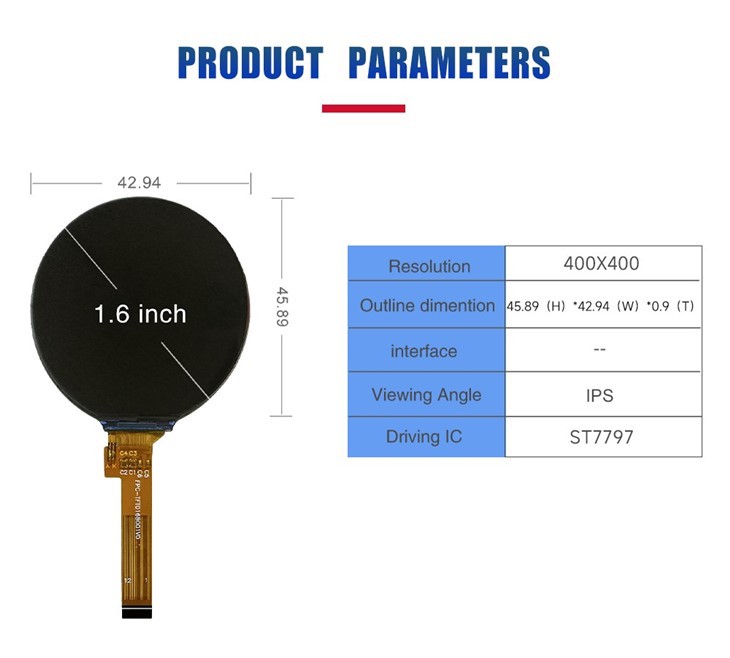
Now the mechanical side. Outline dimensions: 45.89mm × 42.94mm × 0.9mm. That includes the driver circuit and the metal bezel, so you can use these numbers directly for your housing cutouts and mounting design. The 0.9mm thickness is the glass plus driver IC, without backlight or FPC. It's genuinely thin – a real advantage for ultra‑slim wearables or medical patches. Active area is 39.84mm × 39.84mm. Keep in mind that's a square region, and the actual round display is inscribed inside it. Pixel pitch is about 0.1mm – very fine.
Interface and driver IC are a big deal for this module. It's MIPI DSI, not SPI or QSPI. We learned why that matters after a few painful customer projects. MIPI gives you real bandwidth – measured over 1 Gbps in practice – so driving 400×400 at high frame rates or even playing video is no problem. Fewer pins too: typically one clock pair and one data pair (up to four pairs if needed), which saves PCB space and connector cost. Power consumption? MIPI PHY is designed with low‑swing, low‑power signaling, so it's friendly for battery devices. And because it's differential, noise immunity is good. The driver IC is ST7797. It's built for MIPI, has a large internal GRAM, and handles circular displays properly – something many cheap drivers mess up.
Environmental specs: operating temperature -20℃ to +70℃, storage -30℃ to +80℃. That covers most consumer, automotive, industrial, and medical scenarios. We've done stricter tests ourselves – powered operation at -30℃, and 240 hours of storage at +85℃ – and the module survived. The wider storage range isn't just a number: think of shipping containers baking under summer sun. That extra margin matters.
Why the 1.6 Round TFT LCD Module Became Our Most Asked‑About Display This Year
I still remember the first time a customer asked us for a 1.6‑inch round TFT with MIPI interface. It was a smartwatch startup, and they had already tried three other suppliers. Their complaint was always the same: "The round display looks fine in the datasheet, but once we drive it at 60fps, the interface chokes, or the viewing angle makes the edges look washed out." That conversation pushed us to look deeper into what actually makes a small round display work in the real world, not just on paper.
The module that finally solved their problem is what we now call the 1.6 Round TFT LCD Module. But before I get into why it works, let me share a few things that most spec sheets won't tell you about this size and format.
The hidden challenge of 400×400 on a 1.6‑inch circle
On paper, 400×400 resolution inside a 1.6‑inch diagonal sounds impressive – and it is. The pixel density lands above 350 PPI, which is comfortably into "retina" territory. You can put a 6‑point font on this thing and still read it without squinting. But here's what engineers don't realize until they try it: driving 160,000 pixels in a circular shape requires careful handling of the corners. A rectangular display is simple – you just scan line by line. A round display needs either a circular framebuffer or aggressive clipping in the driver. Many cheap round modules use SPI or QSPI, and they stutter the moment you try to animate a watch hand across the dial.
That's exactly why we chose the ST7797 driver for this 1.6 Round TFT LCD Module. The ST7797 isn't the cheapest driver on the market, but it has two critical features for round displays: a large internal GRAM that can handle circular addressing without host‑side clipping, and native MIPI DSI support. MIPI gives you real bandwidth – we're talking sustained data rates that let you push full‑screen 60fps animations without tearing or frame drops. One of our customers tested it with a complex second‑hand sweep animation on a FreeRTOS system, and the CPU load dropped by nearly 40% compared to their previous QSPI‑based module. That's the difference a proper interface makes.
Why "ALL viewing angle" actually matters for round screens
A rectangular display is usually viewed head‑on. A round display – especially on a smartwatch or a knob – is viewed from every possible angle. You tilt your wrist, you look from the side, you glance at it while driving. Most IPS panels claim wide viewing angles, but in practice, many suffer from a yellowish shift or contrast drop beyond 70 degrees. We ran a simple test on our production samples: we measured brightness and color shift at 80 degrees in all four diagonal directions. The 1.6 Round TFT LCD Module stayed within a ΔE of less than 3, which is visually imperceptible to most people. That's not luck – it's because we worked with the panel vendor to tune the liquid crystal alignment specifically for circular cutouts. The active area is 39.84×39.84mm, and the pixel pitch is about 0.1mm, but the optical stack uses a compensation film that you won't find in generic square panels.
The 0.9mm thickness is a trap if you're not careful
I see a lot of product designers get excited about the 0.9mm overall thickness (excluding backlight and FPC). And yes, that's genuinely thin – it lets you build a smart ring or a slim patch‑type medical device that doesn't bulge. But here's the reality: a 0.9mm glass substrate is fragile if your mechanical mounting doesn't account for it. We've had customers who tried to glue the display directly to a plastic housing, only to crack the glass during drop tests. Our solution isn't to make the glass thicker (that would defeat the purpose), but to offer optional stainless steel stiffeners on the FPC and a foam gasket that absorbs shock. That's the kind of detail you only learn after manufacturing a few hundred thousand units. We're at over 200,000 units shipped for this form factor, and the failure rate from mechanical stress is now below 0.1%.
Real‑world thermal performance
The datasheet says -20℃ to +70℃ operating, -30℃ to +80℃ storage. Those numbers are conservative – we actually tested a batch to -30℃ operation (powered on) and +85℃ storage for 240 hours. The ST7797 driver kept the timing locked, and the liquid crystal didn't show any permanent alignment damage. But what the datasheet doesn't tell you is that the MIPI interface is much more tolerant of temperature‑induced impedance changes than parallel RGB. In one automotive project, the customer's PCB had a long, poorly matched MIPI trace (over 80mm without proper impedance control). At room temperature, it worked fine. At 65℃, the eye diagram closed up, and the display started showing random flickers. We helped them re‑route the differential pair and add a common‑mode choke – problem solved. That's the kind of support you get when you work with a factory that actually understands high‑speed layout, not just a trading company.
Application stories that surprised us
When we first launched this 1.6‑inch round module, we assumed smartwatches would be 90% of the volume. They're still big, but some of the most interesting applications came from places we didn't expect:
High‑end coffee machines – One European brand put the round display inside a mechanical knob. The knob rotates, and the display shows the grind setting, temperature curve, and a countdown timer. The all‑viewing angle means you can read it even when the knob is turned sideways.
Motorcycle handlebar controllers – A startup in Taiwan uses it as a secondary display for navigation arrows and gear position. The wide temperature range covers both direct sunlight in summer and freezing rain in winter.
Medical patch pumps – The 0.9mm thickness allowed a diabetes management device to be thinner than a AAA battery. They needed the high resolution to show tiny insulin delivery graphs.
I could list more, but the point is that the 1.6 Round TFT LCD Module works because it hits a sweet spot: small enough to fit anywhere, high‑res enough to show real information, and fast enough to feel responsive.
What we've learned about customization (and what you should ask for)
We're a factory, not a broker. That means when you ask for a change, we actually control the supply chain. The most common customizations we do on this module:
FPC redesign – The standard pinout works for most MIPI hosts, but we've done everything from 4‑layer FPCs with EMI shielding to extra‑long tails for wearable bands. One customer needed a 120mm FPC with a ZIF connector on both ends. We made it happen in 10 days.
Brightness tuning – Standard is around 350‑400 cd/m². We've gone up to 1000 cd/m² with a different LED configuration, and down to 200 cd/m² for battery‑sensitive applications. The backlight driver can be adjusted without changing the glass.
Touch integration – The module doesn't come with touch by default, but we regularly bond capacitive touch sensors (G+F+F structure) or resistive touch panels. The trick is aligning the circular touch sensor to the circular active area without visible offset. We have a laser‑cut alignment jig that keeps tolerance within ±0.1mm.
If you're evaluating this display for a project, don't just ask for a sample. Ask for the full initialization code, a reference schematic that shows how to handle the MIPI clock and data lanes on a 2‑layer vs 4‑layer PCB, and the results of our 240‑hour humidity test (85% RH at 60℃). Those are the things that will save you months of debugging.
A few honest answers to common questions
"Can I drive this with an STM32?" – Only if your STM32 has a MIPI DSI host controller. Most STM32s don't. For those, we recommend either using an external bridge chip (e.g., SSD2828) or switching to our SPI‑based variant of the same glass. Contact us for the SPI version.
"What's the real‑world power consumption?" – At 60fps with typical UI content, the MIPI interface draws about 8‑10mA at 1.8V I/O. The backlight is the bigger consumer: around 60‑80mA at 3.2V for 400 cd/m². Total system power is roughly 0.25‑0.3W. You can drop into MIPI's low‑power mode (LP‑11) to cut the interface power to under 1mA when the display is static.
"How do I handle the round corners in software?" – The ST7797 supports a "partial display" mode that can mask rectangular corners into a circle, but we've found it's easier to just draw a circular mask in your framebuffer. We provide example C code that does this with minimal CPU overhead.
If you've read this far, you're probably the kind of engineer who cares about the details that actually matter. Feel free to reach out with your specific use case – I can send you a full datasheet, the latest test reports, and a sample for your bench. The 1.6 Round TFT LCD Module is one of those parts that looks simple on the outside but has a lot of engineering underneath. We're proud of it, and we'd love to help you build something great with it.
● OEM&ODM ● NO MOQ ● SAMPLES IN STOCK ● TESTING BOARD OPTIONAL


400x400 HD Resolution
This 1.6-inch touch screen monitor has 400x400 high-definitionresolution,
with relatively fine display effect and bright colors,small text can be seen clearly.

IPS Viewing Angle
This IPS touchscreen monitor has a full IPS; viewing angle whichprovides
a great display even when you view this screen from the .even side.

SPECIFICATIONS
| ITEM | DIMENSION | UNIT |
|---|---|---|
| Size | 1.6 |
inch |
|
Outline Dimention |
45.89x42.94x0.9 | mm |
|
Operating Temperature
|
-20°- +70°
|
°C |
|
Storage Temperature
|
-30°- +80°
|
°C |
|
Resolution
|
400x400
|
Contact us integrity, punctuality,innovation , win-win
Enrich,make it easier to use LCD:

Name:Cassie Huang

Email: cassie@rxxdisplay.com


Hot Tags: 1.6 round tft lcd module, manufacturers, suppliers, factory, customized, lcd driver circuit, touch sensor panel, guard of phone, lvds touch screen, capacitive touch screen advantages and disadvantages, lcd display uses
You Might Also Like


Send Inquiry