

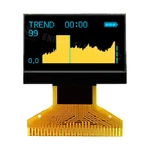


0.96 Inch TFT Display Module
♦Interface:SPI
♦View Direction: ALL
♦Driving IC: NV3022B
♦Touch Screen : Without touch screen(customizable)
ENH-TV0096007A Description
In the world of compact displays, size doesn't tell the whole story. Our 0.96 Inch TFT Display Module proves that exceptional visual performance can come in remarkably small packages. Designed for engineers, product developers, and manufacturers who demand quality without compromise, this module delivers vibrant 80×160 resolution with IPS technology that rivals displays twice its size.
The 0.96 Inch TFT Display Module represents the sweet spot between visual clarity and physical footprint-making it the go-to choice for smart wearables, medical devices, IoT interfaces, and industrial controls where every millimeter matters.
After years of researching and supplying small-size LCD modules, the HSD0.96 0.96-inch TFT display has been one of our most stable-selling products with the most satisfactory customer feedback. It's not because its parameters are stunning, but because it has achieved the ultimate in "adaptability" and "practicality"-many peers easily fall into the trap of "parameter stacking" when making small screens, but overlook the core needs of embedded scenarios: easy integration, clear visibility, and low power consumption. This display precisely addresses all these pain points, and every technical detail has been optimized based on our feedback from thousands of customer trial productions.
Let's start with its display core, which adopts IPS technology-something that's not very common in the 0.96-inch size. Many manufacturers use cheaper TN screens to control costs, but we tried them in the early days and found that TN screens perform poorly in wearable devices. A slight change in viewing angle causes color distortion and poor visibility, especially for health bracelets used by the elderly. Their eyesight is already poor, and color distortion directly affects data reading. That's why we insisted on using IPS. In actual tests, the viewing angle of over 80 degrees in all directions is not a theoretical value from the laboratory; it's the optimal parameter we determined after repeatedly adjusting the fitting angle by installing the screen on bracelet casings of different curvatures. Even when worn on the wrist, whether viewed head-on or from the side, the numbers and icons show no color distortion at all, and the contrast remains stable. Customers who have used TN screen alternatives have given particularly obvious feedback on this point.
The resolution is 80(RGB)×160 pixels. This parameter may seem ordinary, but when combined with the color performance of IPS, it's more than sufficient for a 0.96-inch screen. Many customers initially question whether the pixel count is too low, but through our actual debugging, the pixel density of this resolution is completely clear for displaying basic information such as heart rate, step count, and power, and can even present simple color icons. Moreover, it doesn't increase driving pressure or power consumption due to excessively high pixels-after all, most small screens are used in portable devices, and the balance between power consumption and clarity is more important than simply stacking resolution. It's worth mentioning that its RGB vertical stripe pixel arrangement is specially optimized by us, providing more accurate color reproduction than ordinary arrangements. This is particularly important for displaying warning colors such as red and green, making it suitable for status prompts in medical devices.
The polarizer configuration is a small highlight of this display, and it's a detail we optimized for outdoor use scenarios-the "Upper Matte 83° / Lower Brightness-Enhancing 7°" is not an arbitrarily determined angle. In the early days, some customers reported that the screen had severe reflections outdoors, making it difficult to see, even with a sunshade. We tested polarizers at more than a dozen angles and finally settled on an 83° upper matte polarizer. It not only reduces screen reflections but also doesn't affect screen brightness, and even provides slight fingerprint resistance, eliminating the need for additional surface coating and saving customers production costs. The 7° lower brightness-enhancing design is more practical: it can effectively improve backlight transmittance without increasing backlight power consumption, ensuring the screen remains clearly visible even in low-power mode, which is crucial for battery-powered wearable devices. Furthermore, this configuration does not affect the full viewing angle advantage of IPS at all, achieving a balance between practicality and user experience.
The driver IC used is NV3022B, a chip we have been using for more than three years, which can be regarded as a "stable model" in small-screen drivers. Many peers recommend cheaper driver chips, but we have tried them-those chips either lack integration, requiring additional peripheral circuits that increase customers' R&D difficulty and costs, or have unstable low-power modes, which easily cause screen flickering and blackouts. The advantage of NV3022B lies in its high integration: the built-in GRAM can just support full-color display at 80×160 resolution, eliminating the need for additional external storage. It also supports the SPI serial interface, which only requires 4 signal lines (CLK, DIN, CS, DC) plus power and ground to achieve communication. With fewer pins, it is convenient for customers to solder and debug. Especially for resource-constrained embedded designs, every pin is valuable, and the interface design of this chip can help customers save a lot of GPIO resources. In addition, its low-power mode is very stable. Our actual measurement shows that in sleep mode, the power consumption can drop to the microampere level. Combined with the screen's backlight adjustment function, it can greatly extend the battery life of portable devices, which is one of the core reasons many wearable device customers choose it. Another point is that it is fully compatible with ST7735S-customers who previously developed programs using ST7735S can directly adapt them without major modifications, saving a lot of R&D time. This is also a compatibility design we deliberately retained after long-term communication with customers.
Environmental and dimensional parameters may seem like conventional specifications, but behind each value is our consideration of actual application scenarios. The operating temperature range is -20℃ to +70℃, and the storage temperature range is -30℃ to +80℃. This range is not casually marked; it is confirmed through our repeated thermal shock tests (cycling from -20℃ to +70℃) and low-temperature storage tests that this display can work stably in cold outdoor environments in northern China and hot workshops in southern China without black screens or screen distortion. Previously, a customer used it in outdoor IoT sensors-other brands' screens would experience slow response and color distortion in low-temperature environments in winter, but this display remained stable, which is one of the reputations we have accumulated. In terms of dimensions, 14.04mm × 27.95mm × 1.53mm (length × width × thickness) is a compact size optimized by us based on the casing sizes of current mainstream wearable devices, earphone cases, and small sensors. The elongated proportion is just right for bar-shaped designs, and the thickness of only 1.53mm barely takes up internal device space. Many customers feedback that the size of this display allows their products to be made thinner and lighter, especially smart bracelets and earphone cases, where thinness directly affects user experience. We once had a customer developing an ultra-thin smart ring who couldn't find a suitable screen initially. They tried several screens of similar sizes, but either the thickness exceeded the limit or the display effect was poor. Finally, they used this display, which perfectly fit their casing design, and the failure rate during mass production was very low.
When it comes to quality and customization, this is also our core advantage as a manufacturer. Many customers come to us not just for a standard screen, but for customization according to their specific product needs. Our customization service is not just simple parameter adjustment; instead, we provide customers with reasonable optimization suggestions based on our years of practical experience. For example, the standard brightness is 350cd/m², but if a customer is making outdoor devices that require higher brightness, we will recommend adjusting it to 500-800cd/m² while optimizing the backlight circuit to avoid excessive power consumption. For medical devices, we will suggest anti-glare and anti-fingerprint treatments to improve screen readability in medical environments. In addition, regarding FPC length and shape, and connector type, many customers have special internal device space. We will customize the FPC route and length according to the casing drawings they provide, and even adjust the connector position to ensure smooth installation and reduce rework rates during trial production. Furthermore, our MOQ is low-even if a customer only needs dozens of pieces for sample testing, we can arrange production, which is very friendly for start-ups or customers conducting prototype verification.
To be honest, the specs on this display aren't anything amazing. But it's become our core product because we really understand our customers and the scenarios they're working in. We've seen way too many customers end up with long R&D cycles and high failure rates in mass production, all because they picked screens that looked great on paper but were a pain to actually use. And we've watched plenty of competitors just keep stacking specs while ignoring the basic needs of embedded applications.
Every technical detail on this HSD0.96 display-things like the IPS viewing angle optimization, the polarizer angle selection, the driver IC compatibility, even the dimensional tolerances-came from real-world use cases we've run into and refined over time. The whole point is to make it easier for customers to work with.
It might not be the best small screen out there, but it's definitely the one that fits embedded scenarios best and actually solves problems for customers. That's been our philosophy after all these years of making small LCDs: specs are the foundation, but usability is what really matters.
● OEM&ODM ● NO MOQ ● SAMPLES IN STOCK ● TESTING BOARD OPTIONAL


80*160 HD Resolution
This 0.96-inch touch screen monitor has 80*160 high-definitionresolution,
with relatively fine display effect and bright colors,small text can be seen clearly.

IPS Viewing Angle
This IPS touchscreen monitor has a full IPS; viewing angle whichprovides
a great display even when you view this screen from the .even side.

SPECIFICATIONS
| ITEM | DIMENSION | UNIT |
|---|---|---|
| Size | 0.96 |
inch |
|
Outline Dimention |
14.04x27.95x1.53 | mm |
|
Operating Temperature
|
-20°- +70°
|
°C |
|
Storage Temperature
|
-30°- +80°
|
°C |
|
Resolution
|
80x160
|
Contact us integrity, punctuality,innovation , win-win
Enrich,make it easier to use LCD:

Name:Cassie Huang

Email: cassie@rxxdisplay.com


Hot Tags: 0.96 inch tft display module, manufacturers, suppliers, factory, customized, display manufacturing companies, display tft lcd, lcd screen touch, mobile cover and screen guard, TFT LCD Module, tft panel display
You Might Also Like


Send Inquiry