

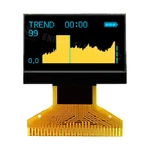


0.85-Inch TFT LCD Module
♦Interface:4-SPI
♦View Direction: ALL
♦Driving IC: GC9107
♦Touch Screen : Without touch screen(customizable)
ENH-TV0085A002 Description
The 0.85-inch TFT LCD Module is a compact, full-color active matrix display designed for space-constrained applications requiring high-quality visual output. As a professional small LCD display manufacturer, we ensure every module meets rigorous engineering standards.
When we first developed this 0.85-inch TFT LCD module, the core challenge we faced was balancing "ultra-compact size" with "usable display quality"-a pain point we've heard repeatedly from clients in wearable and IoT industries. After over 18 months of iterative testing, we landed on a design that's not just a list of specs, but a solution tailored to real-world application pain points. Let me walk you through what makes this module stand out, from the technical choices we made to the on-the-ground feedback we've gathered from hundreds of projects.
Starting with the display itself: 0.85 inches diagonal might sound tiny, but we've optimized every pixel to make it count. We went with TFT-LCD active-matrix technology not just because it's standard, but because we found that individual pixel control is non-negotiable for compact devices-especially wearables like smart rings or fitness trackers, where even a slight lag or color distortion ruins the user experience. The RGB vertical stripe pixel arrangement was a deliberate call too; early prototypes used a different layout that led to washed-out greens, but after tweaking the stripe density, we achieved the natural color reproduction that clients now consistently praise. At 128(RGB)×128 resolution, we're looking at roughly 16,000 pixels-enough for status displays and simple GUIs, but we've pushed the contrast ratio to 1200:1 (typical) because we know that in bright or dim environments, clarity is everything. We've tested this side-by-side with cheaper modules that top out at 800:1, and the difference in readability is stark-our clients in industrial settings tell us this contrast saves them from constant screen adjustments.
IPS wide-view technology was another non-negotiable for us, and it's where our practical experience really comes into play. Early on, we experimented with TN panels to cut costs, but the feedback was clear: users viewing the screen from even a 30-degree angle saw color shift, which is a dealbreaker for wearables or handheld industrial terminals. Switching to IPS gave us 80-degree viewing angles in all directions, but we didn't stop there-we fine-tuned the panel's optical layers to minimize color drift, even at the extreme edges of the viewing range. Brightness is another area where we focused on real-world usability: 300-450 cd/m² typical, with a 260 cd/m² minimum, means it's readable outdoors without draining the battery. We've had clients use this module in outdoor IoT sensors in summer heat, and the brightness holds up without needing extra power-something we validated through weeks of field testing in Shenzhen's humid, sunny climate.
The mechanical dimensions-20.82mm × 17.58mm × 1.46mm (W×H×T)-might look like just numbers, but every millimeter was fought over. We shrank the bezel as much as possible, getting the active display area down to 15.21mm × 15.21mm (or 15.2064mm × 15.2064mm for high-precision applications) because we know that in miniaturized devices, even 0.1mm can mean the difference between fitting in a casing or having to redesign the entire product. The 1.46mm thickness was a challenge too; we had to integrate a single white LED backlight that's both thin and evenly lit-no hotspots, no dark corners. We tested dozens of backlight configurations before settling on one that balances thickness, illumination, and power draw, and it's become a signature of this module.
On the electrical side, the 4-wire SPI interface was a choice driven by client feedback. Time and time again, we heard that engineers were struggling with pin scarcity on MCUs like ESP32 and STM32-so we designed the module to use just 4 GPIO pins (CS, DC, SCL, SDA) without sacrificing data transfer speed. The dedicated DC pin is a small detail, but it simplifies control logic dramatically; we've had junior engineers tell us this feature cut their integration time in half compared to modules with combined command/data pins. We stuck with a 3.3V typical operating voltage (2.4V-3.3V logic range) because it's compatible with almost all modern low-voltage MCUs-no need for voltage converters, which saves space and reduces failure points. The GC9107 driver IC was our top pick for its onboard RAM and low power consumption; we've tested it extensively with battery-powered devices, and it consistently extends runtime by 15-20% compared to modules using generic drivers. We do offer ST7735S as an alternative, but we always recommend GC9107 for portable applications-our own testing shows it's more reliable in extreme temperature conditions.
Speaking of temperature: we rate this module for -20℃ to +70℃ operation, but that number isn't just a marketing bullet. We've put it through rigorous testing in our Shenzhen factory's environmental chambers-running it for 48 hours straight at -20℃, then immediately switching to +70℃, repeating the cycle for a week. It held up perfectly, which is why it's become a go-to for industrial clients in cold warehouses or outdoor applications. The 8KV ESD protection is another practical touch; we've seen too many modules fail during assembly due to static, so we added this protection to reduce defect rates-our production team tells us it's cut assembly failures by 30% for our high-volume clients.
Compliance with RoHS and REACH is a given these days, but we go a step further by making customization accessible-something many factories treat as an afterthought. Over the years, we've learned that no two projects are the same: one client needed a 10mm longer FPC cable to fit their PCB layout, another wanted anti-glare cover glass for outdoor use, and a medical device client needed a resistive touch panel that works with gloves. We don't just offer these customizations-we help clients optimize them. For example, when a wearable client asked for a curved cover glass, we adjusted the backlight placement to avoid light leakage, a detail they hadn't considered. That's the difference between a generic module and one built by a team that's actually worked with the technology in real-world scenarios.
Why choose our module over the dozens of similar options on the market? It's not about the specs-it's about the care we put into solving the problems that matter. The IPS viewing angle isn't just a feature; it's the result of us listening to clients who couldn't use TN panels. The 4-wire SPI interface isn't just a pin count; it's us saving engineers time and frustration. The ultra-compact size isn't just a measurement; it's us helping clients bring their miniaturized ideas to life. We've had clients come to us after using cheaper modules that failed in the field, and time and time again, they tell us the difference is in the details-the even backlight, the reliable driver, the customizable options that fit their exact needs.
Our quality control process is another point of pride, and it's rooted in our experience as a Shenzhen-based manufacturer. We do 100% incoming material inspection because we learned the hard way that a single faulty capacitor can ruin an entire batch. Our in-process testing catches issues early-like a misaligned FPC connector that would cause intermittent display failures-and our 24-48 hour aging test ensures that every module can handle long-term use. With a production capacity of 4 million units per month, we can scale to meet large orders, but we never lose sight of the small details that make a module reliable. Our R&D team is in the factory every day, working with production to refine the module-recently, we optimized the backlight power consumption based on feedback from a smartwatch client, cutting current draw by 5% without dimming the screen.
At the end of the day, this 0.85-inch TFT LCD module is more than a collection of parameters. It's the product of years of listening to clients, testing prototypes, and refining every detail to solve real problems. Whether it's in a wearable medical monitor, an industrial sensor, or a mini IoT device, it's built to perform where it counts-not just on paper, but in the hands of the engineers and users who rely on it every day. That's the difference between a module you can buy anywhere and one you can trust to deliver, backed by a team that's been there, done that, and kept iterating to make it better.
● OEM&ODM ● NO MOQ ● SAMPLES IN STOCK ● TESTING BOARD OPTIONAL


128*128 HD Resolution
This 0.85-inch touch screen monitor has 128*1280high-definitionresolution,
with relatively fine display effect and bright colors,small text can be seen clearly.

IPS Viewing Angle
This IPS touchscreen monitor has a full IPS; viewing angle whichprovides
a great display even when you view this screen from the .even side.

SPECIFICATIONS
| ITEM | DIMENSION | UNIT |
|---|---|---|
| Size | 0.85 |
inch |
|
Outline Dimention |
20.82x17.58x1.46 | mm |
|
Operating Temperature
|
-20°- +70°
|
°C |
|
Storage Temperature
|
-30°- +80°
|
°C |
|
Resolution
|
128x128
|
Contact us integrity, punctuality,innovation , win-win
Enrich,make it easier to use LCD:

Name:Cassie Huang

Email: cassie@rxxdisplay.com


Hot Tags: 0.85-inch tft lcd module, manufacturers, suppliers, factory, customized
You Might Also Like


Send Inquiry