

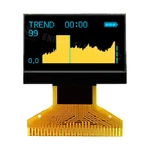


0.42 Inch TFT LCD Module
♦Interface: 4-SPI
♦View Direction: ALL
♦Driving IC: ST7735P3
♦Touch Screen : Without touch screen(customizable)
ENH-TV0042A002 Description
Parameter Discussion
96×54 resolution. On a 0.42-inch active area (roughly 9.22mm wide by 5.18mm tall), 96×54 yields about 265 PPI horizontally. That is noticeably sharper than many 1.x‑inch wearables. The aspect ratio - roughly 16:9 - happens to match common video thumbnail proportions. In practice, 96 columns are enough for three to four alphanumeric characters plus a small icon, making the display suitable for numerical readouts (glucose 5.6, battery 96%, temp 23.5°) or short status strings.
ST7735P3 driver. This driver contains on‑chip GRAM (typically 132×162×18 bits) and handles 96×54 without any external frame buffer. The built‑in GRAM removes the need for an expensive external RAM chip, a real cost consideration in high‑volume devices like TWS charging cases. SPI keeps pin count low: CLK, MOSI, CS, DC (and RESET optional) - that is 4 to 5 signals plus power and ground.
Active area and outline. The 12.32 × 12.09 × 1.5 mm module shape is essentially a mini‑square. The active area is 9.22 × 5.18 mm. This leaves enough bezel for mechanical support while staying small enough for devices that fit inside a 20‑25mm housing diameter - exactly what many TWS charging case and smart ring designs require.
IPS viewing direction. "Full viewing angle" or "All" matters when a user glances at a charging case from the side or a wristband from an angle. The 80‑degree cone in each direction ensures that the display remains readable even when the user does not look straight at it. That is not just a comfort feature; for devices used outdoors or in motion, it directly affects usability.
4-wire SPI. For 96×54, a maximum theoretical SPI bandwidth of ~10–20 MHz (practical) is sufficient for full‑screen refresh at well above 30 fps. In real‑world UI scenarios - a battery icon, a percentage, a small animation - the bus is rarely saturated. The low pin count means easier PCB routing and smaller FPC connectors, which translates to lower assembly cost, a non‑negotiable factor in consumer wearables.
2. Key Features and Functional Advantages
Ultra‑compact footprint. The total module area is about 150 mm² - not much larger than a pinky nail. From our shipments, this size class is most sought after by designers of TWS earphone charging cases, smart rings, compact medical readers, and industrial micro‑sensors.
Embedded GRAM. No external RAM is required. For a high‑volume product, eliminating an external memory chip reduces BOM cost by roughly $0.30–0.80 per unit, which becomes significant at 100k units.
Efficient interface. The 4‑SPI bus uses only four active signals. In designs where every GPIO matters (e.g., low‑pin‑count MCUs in earbud cases), this is a major advantage.
Standardized driver. ST7735 driver series is common in maker communities and industrial designs alike. We also ship complete initialization sequences for STM32, ESP32, Arduino, and 8051. Many engineers can integrate the display within a single day when using our pre‑tested code.
Built‑to‑last supply. For this module, we guarantee at least 10 years of continuous supply after product launch, a promise aimed at medical and industrial customers who need long‑term stability.
RoHS compliance. The entire module meets RoHS and REACH standards, required for EU shipments and medical device compliance.
3. Application Areas
The following sections list where our customers are actually using this module, based on our shipment records.
TWS earphone charging cases. The 0.42‑inch size fits neatly into the lid or front face of compact earbud batteries. Typical use: displaying battery percentage for left/right buds, case battery level, Bluetooth pairing status, and charging animation. The 96×54 resolution and 16:9 aspect ratio align nicely with small status icons.
Smart rings. A ring wearable has extremely tight interior space, often just 15‑18mm inner diameter. The 12.32×12.09×1.5mm module slides into such designs more readily than 0.7‑inch alternatives. Applications include showing heart rate zones, step progress, or caller ID.
Micro medical readers. Handheld glucose monitors, fingertip pulse oximeters, and compact body‑temp readers benefit from the low power draw (backlight ~20‑40 mA typical) and crisp numeric display. The -20°C to +70°C operating range supports field use.
Industrial sensors. Temperature/humidity meters, small pressure gauges, and portable calibration tools use these displays for on‑device status readouts. The soldering‑type FPC stays secure in equipment that experiences shock or vibration.
DIY embedded projects. The 4‑SPI interface and available code examples for STM32, ESP32, and Arduino make the module a popular choice for portable data loggers and miniature instrumentation.
IoT edge devices. Any sensor node that needs a direct "what is the value right now" display can use this module. Power management is flexible: sleep mode current is under 10 µA, letting the product present information on demand without draining the battery in standby.
Consumer goods accessories. E‑liquid levels on vaping devices, microphone battery displays on portable recorders, and other small accessories use the module due to size and low cost.
Recent industry reports note that tiny TFT displays in the 0.7–2.0 inch range must balance size, readability, power, and durability - our 0.42‑inch IPS variant successfully meets these requirements for several product categories.
4. Product Details and Visual Features
The module uses a soldering‑type FPC, typically 16 pins with 0.5mm pitch. No ZIF connector is necessary - the FPC is designed for hand or hot‑bar soldering directly onto the host PCB. For a one‑off medical device with low volume, this reduces connector cost. For a high‑volume TWS case, pick‑and‑place assembly is straightforward when the placement paste stencil and reflow profile are set correctly.
Backlight. One white LED drives the backlight. Standard brightness is 350 cd/m², which is comfortable for indoor use and adequately visible in office or home lighting. For applications that need a brighter backlight - for example, a device intended for outdoor daily carry - we offer custom boost‑up brightness options up to 600‑1000 cd/m², though this comes with slightly higher power consumption and shorter LED life.
Polarizer and optics. The IPS‑grade polarizer stack provides full viewing angle but also incorporates an anti‑glare surface treatment as standard. This reduces reflections from overhead lights in control rooms or bright shops, while maintaining sufficient contrast for UI elements. Contrast ratio of 800:1 ensures that text and symbols separate cleanly from the background.
Optional cover glass. A tempered glass lens can be added, with anti‑glare (AG), anti‑fingerprint (AF), or silk‑printed logo decoration. Optical bonding eliminates the air gap between the glass and panel, improving sunlight readability and preventing condensation.
Capacitive touch. For 0.42‑inch displays, touch integration is possible but less common due to limited UI surface area. We support integration of a capacitive touch overlay using FT3267 or CST816 controllers; custom FPC for touch is also available. Most of our 0.42‑inch customers, however, skip touch and rely on physical buttons or app‑based controls to preserve battery life.
5. Quality Assurance
RoHS compliant (lead‑free materials)
REACH compliant (EU chemical safety standards)
ISO 9001:2015 (quality management)
ISO 14001:2015 (environmental management)
6. Customization Services
| Customization Category | Options |
|---|---|
| FPC Customization | Length (15 mm to 200 mm), exit direction (bottom/side/custom angle), connector type (ZIF/pin header/custom soldering pads), mounting holes, gold finger dimensions. Tooling ~3‑4 weeks. |
| Cover Glass | Tempered AG/AF coatings, silk‑printed logos, optical bonding for outdoor use. ~4‑5 weeks tooling. |
| Touch Panel | Capacitive (FT3267 / CST8xx) ~0.6‑0.8mm added thickness; capacitive is more responsive but costlier. Resistive touch available for glove‑compatible industrial designs. |
| Brightness | Standard 350 cd/m². High‑brightness versions up to 800‑1000 cd/m². |
| Interface | 4‑wire SPI stays standard. 3‑wire SPI possible; MCU 8‑bit parallel available for legacy designs. |
| Operating Temp |
Standard -20°C to +70°C. Extended -30°C to +80°C available (LCD fluid & adhesive change). |
Ready to Integrate the 0.42-inch TFT LCD Module?
The 0.42-inch size sits at a unique intersection: it is large enough to display meaningful status information yet small enough to fit into products where every millimeter counts. The 96×54 resolution, 4‑SPI interface, and IPS technology combine to deliver a practical building block for TWS charging cases, smart rings, medical readers, and industrial sensors.
Contact our engineering team directly for a datasheet, a sample order, or to discuss your FPC and cover glass customization needs. We have kept sufficient stock for sample-sized orders, and we are ready to support you from initial prototype testing all the way to volume production.
● OEM&ODM ● NO MOQ ● SAMPLES IN STOCK ● TESTING BOARD OPTIONAL


96x54 HD Resolution
This 0.42-inch touch screen monitor has 96x54 high-definitionresolution,
with relatively fine display effect and bright colors,small text can be seen clearly.

IPS Viewing Angle
This IPS touchscreen monitor has a full IPS; viewing angle whichprovides
a great display even when you view this screen from the .even side.

SPECIFICATIONS
| ITEM | DIMENSION | UNIT |
|---|---|---|
| Size | 0.42 |
inch |
|
Outline Dimention |
12.32x12.09x1.5 | mm |
|
Operating Temperature
|
-20°- +70°
|
°C |
|
Storage Temperature
|
-30°- +80°
|
°C |
|
Resolution
|
96x54
|
Contact us integrity, punctuality,innovation , win-win
Enrich,make it easier to use LCD:

Name:Cassie Huang

Email: cassie@rxxdisplay.com


Hot Tags: 0.42 inch tft lcd module, manufacturers, suppliers, factory, customized, mobile cover and screen guard, lcd driver circuit, matte screen protector over tempered glass, lcd display uses, capacitive touch screen examples, kingtech display
You Might Also Like



Send Inquiry