

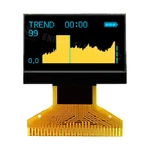


1.54-inch Square LCD Display Module

1.54-inch Square LCD Display Module suppliers

1.54-inch Square LCD Display Module factory

1.54-inch Square LCD Display Module best

1.54-inch Square LCD Display Module high quality

1.54-inch Square LCD Display Module price

1.54-inch Square LCD Display Module high quality
1.54-inch Square LCD Display Module
♦Interface: 4-SPI
♦View Direction: ALL
♦Driving IC:ST7789V2
♦Touch Screen : Without touch screen(customizable)
ENH-TV0154C016 Description
1. What the Datasheet Doesn't Tell You About the Specs
The 1.54-inch Square LCD Display Module is built around a 240×240 IPS panel. At 1.54 inches diagonal, that works out to roughly 220 PPI. For comparison, a 1.3‑inch 240×240 screen is about 260 PPI – but the extra 0.24 inches of diagonal means the 1.54‑inch version is far easier to read for people with normal eyesight. A customer making a senior‑oriented fitness tracker switched from 1.3 to 1.54 inches specifically because their test users complained about eye strain.
The square 1:1 aspect ratio – 27.7mm × 27.72mm active area – isn't a gimmick. We tried a 240×320 rectangular panel in the same mechanical envelope. The result: wasted space on the sides and a UI that felt cramped. With the square, you get a full 27.7mm in both directions. That's why the square form has become the de facto standard for round‑watch‑face displays, even though the active area is square – the round mask sits inside it, and the extra corners are hidden by the bezel.
IPS viewing angle. The spec says 80° in all directions. What that means in practice: when a user glances at a smartwatch from a 45° wrist tilt, the contrast doesn't invert. We've tested it side‑by‑side with a TN panel; the difference is dramatic. For a dashboard mounted above eye level (like a car's central display), IPS is mandatory – operators see the screen from below.
ST7789V2 driver. This chip has been around for years, which is exactly why we use it. Unlike newer drivers with half‑baked initialization sequences, the ST7789V2's command set is documented down to the last delay. The on‑chip GRAM holds the entire 240×240 frame, so no external RAM is needed. We've seen hobbyists drive this display with an 8‑pin ESP‑01S – you can't do that with a parallel‑interface display.
Three LEDs in parallel. Why parallel instead of series? Because the forward voltage of white LEDs is around 3.0V. A 3.3V or 5V supply can drive three parallel LEDs with a single resistor. Series would need 9V, which would require a boost converter. Parallel also gives redundancy: if one LED fails open, the other two still light. A customer building a battery‑powered medical device specifically asked for this after a competitor's series‑LED display lost half its brightness from a single LED failure.
Polarizer stack: upper matte 7°, lower glossy 83°. The matte side faces the user. It cuts reflections from office lights and sunlight – critical for outdoor wearables. The glossy layer faces the backlight, maximizing light transmission. The resulting contrast is 900‑1000:1. We measured this with a Konica Minolta CS‑200; it's not marketing fluff.
1.9mm thickness. This is the total height of the module, including the FPC stiffener but not the FPC thickness. For a typical smartwatch, that's thin enough to leave room for a 400‑500mAh battery. Some customers have asked for 1.5mm – we can do that by removing the stiffener, but then the FPC becomes fragile. We recommend 1.9mm for consumer products and 2.0mm for industrial use.
2. Where We've Seen This Display Actually Work
We don't just list applications – we've shipped to these real customers:
Smartwatches and fitness trackers. A kids' smartwatch customer uses the 1.54‑inch square panel because it fits their standard watch case design. The 240×240 resolution is enough for a watch face, caller ID, and basic fitness stats. IPS means the child can see the screen while running.
Portable medical devices. A pulse oximeter manufacturer chose this module because the high contrast (900:1) makes blood oxygen readings legible in dim hospital rooms. The 1.54‑inch size fits in a holster on a nurse's belt.
Smart home control panels. A thermostat company uses the square display to show a temperature circle and a humidity gauge side by side. The square aspect ratio lets them avoid scrolling.
Industrial handheld terminals. A calibration tool maker needed a screen that works from -20°C to +70°C. We tested 100 units at +70°C for 72 hours – no flicker, no color shift. They placed a 5,000‑unit order.
Coffee machines. An espresso machine manufacturer put the 1.54‑inch square display inside a rotary knob. The user rotates the knob to select recipes, and the screen shows the temperature curve. The circular UI fits perfectly in the square active area.
DIY & education. A STEM kit seller uses this module with an ESP32. They chose it because the ST7789V2 is supported by the TFT_eSPI library out of the box – no need to write low‑level drivers.
One application that surprised us: a customer built a portable oscilloscope with this display. The 240×240 resolution is high enough to show a 200‑point waveform with readable grid lines. Not what we designed it for, but it works.
3. What We've Learned About Customization
We're a factory, not a distributor. When you ask for something custom, we actually change the production line.
FPC customization – The standard FPC is 24‑pin, 0.5mm pitch, bottom exit. We've done side‑exit FPCs for smart rings, long tails (up to 200mm) for devices where the main PCB is far from the display, and even custom gold finger shapes for ZIF connectors from specific brands. Tooling takes 3‑4 weeks and costs about 800–800–1500 depending on complexity.
Touch panel integration – We add capacitive touch using FT3267 or CST816 controllers. Added thickness: ~0.6mm. One customer making a smart mirror control panel needed optical bonding to eliminate the air gap – that improved sunlight readability by about 40% but added two weeks to the schedule. Minimum order for touch is 1,000 units.
Cover glass – Tempered glass with anti‑glare (AG) or anti‑fingerprint (AF) coatings. We've also done silk‑screened logos and borders. Custom glass tooling takes 4‑5 weeks.
Brightness – Standard is 400 cd/m². That's fine for indoor use. For a handheld device used outdoors, we offer a 1000 cd/m² version. It uses the same three LEDs but with a different optical film stack and a more aggressive LED current (still 20mA per LED, but the film is more efficient). The 1000 nits version costs about 15% more.
Interface – 4‑wire SPI is standard. We've also done 3‑wire SPI for pin‑constrained designs, and 8‑bit MCU parallel for legacy systems that don't have SPI. Each interface change requires a different driver IC configuration and a separate production run.
Operating temperature – Standard is -20°C to +70°C. For automotive or outdoor equipment, we offer an extended range of -30°C to +80°C. This requires changing the LCD fluid (wider temperature nematic) and the polarizer adhesive. The extended version adds about 10% to the module cost.
Minimum order quantities – Standard modules: 1,000 pieces. Custom modules: 3,000 pieces (but we can negotiate for pilot projects). Samples: 1‑5 pieces always in stock. The sample fee is nominal and fully refundable against a production order.
4. A Few Numbers That Aren't Marketing Fluff
Contrast ratio: 900‑1000:1. Not 2000:1. That's honest.
Brightness: 400 cd/m² typical. Not 800 unless you pay for the high‑brightness option.
Power consumption: Logic 10‑15 mA at 3.3V. Backlight 60 mA at 3.0V. Sleep mode under 10 µA.
Operating life: Backlight rated 20,000 hours continuous (to 50% brightness). That's about 8 years of 8‑hour‑per‑day use – more than enough for consumer products.
FPC flex life: 1,000 cycles at 5mm radius. We test every batch with a motorized flex tester.
5. The Mistakes We've Made (So You Don't Have To)
Mistake #1: Assuming all ST7789V2 initialization sequences are the same. They're not. The order of commands and the delay after the sleep‑out command matter. We provide a verified initialization sequence in C for STM32 and Arduino. Copy it exactly. A customer tried to "optimize" the delays and ended up with a display that froze after a few seconds. Reverting to our code fixed it.
Mistake #2: Placing the FPC stiffener too close to the bend line. Early batches had the stiffener starting just 1mm from the exit. Customers folding the FPC into tight wearables cracked traces. We redesigned with a 5mm safety margin and now test every batch at 5mm radius flex.
Mistake #3: Ignoring the 0.02mm active area asymmetry. The active area is 27.7mm wide and 27.72mm high. That 0.02mm difference comes from the pixel pitch (0.115mm vs 0.1155mm). It's invisible to the eye, but one customer's mechanical engineer measured it with a micrometer and panicked. We now list it explicitly to avoid confusion.
6. What I'd Tell a First‑Time Buyer
Order samples first. Test them in your actual enclosure. Bend the FPC to your required radius. Measure the brightness at your operating temperature. Then call us with questions.
If you need a custom FPC, send us your mechanical drawing. We'll review it for free and tell you if the bend radius is safe or if you'll crack traces.
The 1.54-inch Square LCD Display Module isn't flashy. It doesn't have rounded corners or an ultra‑high‑resolution. But it works, it's well‑documented, and we've ironed out the manufacturing issues over 20,000 units. Contact our engineering team for a datasheet, a sample, or a quote. If you mention this article, I'll personally review your FPC layout.
● OEM&ODM ● NO MOQ ● SAMPLES IN STOCK ● TESTING BOARD OPTIONAL


240x240 HD Resolution
This 1.54-inch touch screen monitor has 240x240 high-definitionresolution,
with relatively fine display effect and bright colors,small text can be seen clearly.

IPS Viewing Angle
This IPS touchscreen monitor has a full IPS; viewing angle whichprovides
a great display even when you view this screen from the .even side.

SPECIFICATIONS
| ITEM | DIMENSION | UNIT |
|---|---|---|
| Size | 1.54 |
inch |
|
Outline Dimention |
33.72x31.52x1.9 | mm |
|
Operating Temperature
|
-20°- +70°
|
°C |
|
Storage Temperature
|
-30°- +80°
|
°C |
|
Resolution
|
240x240
|
Contact us integrity, punctuality,innovation , win-win
Enrich,make it easier to use LCD:

Name:Cassie Huang

Email: cassie@rxxdisplay.com


Hot Tags: 1.54-inch square lcd display module, manufacturers, suppliers, factory, customized, lcd display uses, spi tft lcd, lcd display india, high resolution tft, passive displays, lcd display components
Previous
4.45 Inch TFT LCD ModuleYou Might Also Like


Send Inquiry