



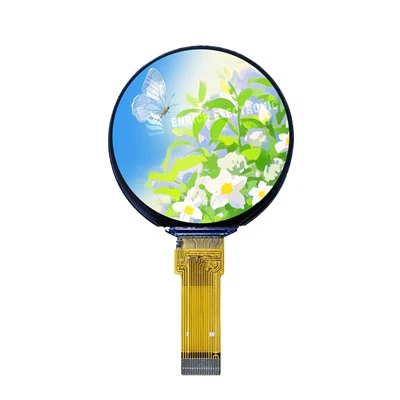
2.1 Inch Circular TFT LCD Module
♦Interface:3W-SPI+RGB666
♦View Direction: ALL
♦Driving IC:ST7701S
♦Touch Screen : Without touch screen(customizable)
ENH-TV0210A001 Description
I'm the engineering lead at a small‑to‑medium LCD factory. We don't make every display under the sun, but we've focused on round and special‑shaped modules for the past five years. The 2.1 Inch Circular TFT LCD Module is one of our most requested parts, and along the way we've made mistakes, corrected them, and developed a few opinions that you won't find in a standard datasheet.
Let me start with a confession: our first batch of 2.1‑inch round displays had an FPC design that worked perfectly on paper but failed in real products. The round shape meant the flex circuit bent at an awkward angle inside a smartwatch housing. After that, we redesigned the stiffener placement and added a small slit to relieve strain. That's the kind of detail we now include as a standard feature, not a customization. But it's also why I'll never claim that a circular display is "just a rectangular screen with corners cut off." It's not.
The ST7701S Isn't Just Another Driver
Most buyers look at the driver IC and think, "It works, next." But we've run into enough edge cases to know that the ST7701S has a few quirks that matter. For example, the 3‑wire SPI + RGB666 combination we use isn't arbitrary. We originally offered a full 24‑bit RGB interface, but customers kept complaining about PCB routing difficulties on tiny smartwatch boards. The RGB666 variant cuts the data lines from 24 to 18 without a visible loss in color quality for 16.7M colors. The result is a cleaner layout and fewer signal integrity headaches.
One of our automotive clients needed MIPI DSI instead of RGB. We spent three weeks validating a 1‑lane MIPI variant of the same 2.1‑inch panel. It's available now, but honestly, most embedded projects don't need it. The SPI+RGB666 sweet spot handles 480×480 at 60 fps with an ESP32‑S3, which is more than enough for watch animations or knob UI transitions.
1000:1 Contrast and the "Black That Stays Black"
Contrast ratio is often listed as a marketing number. On this panel, it's real. The normally‑black IPS mode means when you send a black pixel command, the liquid crystals twist to block almost all light. In a dark room, the display blends into the bezel. But the practical win is outdoor readability. At 300 nits (our standard brightness), the contrast still helps, but we've learned that customers making smart home rotary knobs for sunny kitchens eventually ask for 800‑1000 nits. We now offer a high‑brightness backlight option that uses the same LED count (4 LEDs) but with a different optical film stack. The current per LED stays at 20 mA, so the power draw doesn't double.
A medical device customer once told me that the difference between 800:1 and 1000:1 contrast meant their nurses could read the display without tilting the device. That's the kind of feedback that stays with you.
Where the 2.1‑Inch Circular TFT Actually Fails (And How We Fixed It)
I'm not here to sell you a perfect product. The 2.1 Inch Circular TFT LCD Module has limitations, and you should know them.
First, the viewing angle is listed as "ALL" because it's IPS, but there's still an optimal orientation. The polarizer is cut with a specific slow axis. If you mount the display upside down relative to that axis, you'll see a slight color shift at extreme angles. We provide the polarizer angle in the mechanical drawing (upper 83°, lower 7° brightness enhancement). Follow it.
Second, the 70% NTSC color gamut is fine for most UIs, but if you're matching a specific brand color or displaying medical images with subtle gradients, you might want our custom gamut adjustment. We can tweak the color filter material, but it requires a minimum order. For 90% of smartwatch and knob applications, 70% NTSC is already overkill.
Third, the FPC is 0.5mm pitch, 15 pins. That's fine for most designs, but we've had customers who needed a wider pitch for hand soldering. We now offer a 1.0mm pitch version as a custom option. It costs more, but it saves assembly headaches.
Customization Isn't a Buzzword Here
Because we're the factory, not a distributor, "custom" means we actually change the production line. When you ask for a different FPC shape, we don't just cut a longer tail – we revise the tooling. That takes time (usually 3‑4 weeks) and a modest NRE. But it also means you get exactly what your enclosure needs.
Here's a real example: a customer making a smart ring wanted the display FPC to exit from the side, not the bottom. We rotated the bonding pad layout on the glass, which required re‑qualifying the ACF bonding process. It added two weeks and $800 in tooling. They ordered 5,000 units. That's a win‑win.
We also offer touch integration – capacitive (FT3267 or CST826) or resistive. The capacitive overlay uses a G+FF structure, which adds about 0.6mm to the total thickness. For a smartwatch, that's noticeable. For a knob display, it's fine. We'll send you a cross‑section drawing before you commit.
A Few Notes on Temperature and Lifetime
The operating range is -20°C to +70°C, storage -30°C to +80°C. Those are tested numbers, not extrapolations. We ran 100 units through 72 hours at +70°C with the backlight on. No flicker, no permanent image retention. The low‑temp storage test at -30°C for 168 hours caused no glass cracks. However, if you need -40°C operation, this isn't the right panel. We have other models for that.
Backlight lifetime is rated at 20,000 hours continuous. That's typical for white LEDs. In real‑world use (dimming, intermittent operation), you'll get longer. We've had a customer's fitness tracker running for three years without a noticeable drop in brightness.
Samples: The Best $20 You'll Spend
We keep a small stock of the standard 2.1 Inch Circular TFT LCD Module for sample orders (1‑5 pieces). The sample fee is nominal and refundable against a production order. I strongly recommend ordering a few before you finalize your PCB layout. Why? Because the mechanical drawing shows dimensions, but it doesn't show how the FPC behaves when you bend it 90 degrees. It doesn't show the exact shade of black under your specific backlight driver. We've seen customers save weeks of rework by testing samples early.
Let's Talk About What You're Building
I've written this from a factory perspective because I believe engineers and buyers deserve straight talk. The 2.1 Inch Circular TFT LCD Module is a solid part, but it's not magic. It works well for smartwatches, rotary knob interfaces, medical handhelds, and industrial pendants. It struggles if you need ultra‑wide temperature, or if your PCB is extremely cramped. We're happy to share our failures as well as our successes.
If you have a project in mind, send us an email. We'll reply with a datasheet, a sample quote, and maybe a question or two about your mechanical constraints. And if you mention this article, I'll personally review your FPC layout for free.
● OEM&ODM ● NO MOQ ● SAMPLES IN STOCK ● TESTING BOARD OPTIONAL


480*480 HD Resolution
This 2.1 inch touch screen monitor has 480*480 high-definitionresolution,
with relatively fine display effect and bright colors,small text can be seen clearly.

IPS Viewing Angle
This IPS touchscreen monitor has a full IPS; viewing angle whichprovides
a great display even when you view this screen from the .even side.

SPECIFICATIONS
| ITEM | DIMENSION | UNIT |
|---|---|---|
| Size | 2.1 |
inch |
|
Outline Dimention |
56.0x59.0x2.26 | mm |
|
Operating Temperature
|
-20°- +70°
|
°C |
|
Storage Temperature
|
-30°- +80°
|
°C |
|
Resolution
|
480x480
|
Contact us integrity, punctuality,innovation , win-win
Enrich,make it easier to use LCD:

Name:Cassie Huang

Email: cassie@rxxdisplay.com


Hot Tags: 2.1 inch circular tft lcd module, manufacturers, suppliers, factory, customized, capacitive touch screen examples, kingtech lcd, lcd display india, high resolution tft, capacitive touch screen means, lvds touch screen
You Might Also Like


Send Inquiry